ELECTROMAGNETIC CONTROL SYSTEM
An electromagnetic control system activates the various parts of a machine, at the right moment and for the right amount of time, ensuring that the machine functions properly.
Electromagnetic control systems often use cams and limit switches.
CAM SWITCH CONTROLLER
A camshaft is a cylindrical device with protrusions that make contact with other devices in order to activate or desactivate them.
The shape of a cam allows us to control the moment and duration of an activity, such us the running of a motor or the illumination of a light bulb.
LIMIT SWITCHES
A limit switch detects when preassure is being applied to it. There are two types of limit switch: NORMALLY CLOSED (N/C) and NORMALLY OPENED (N/O)
domingo, 23 de abril de 2017
martes, 11 de abril de 2017
miércoles, 5 de abril de 2017
EFFECTS OF ELECTRIC CURRENT
Heat
The energy that an electric current produces in the form of heat is called the Joule Effect. It is expressed by the following formula:
E=I2xRxt
Light
There are varioues ways that electricity can be used to produce light
Incandescent bulbs
When an electric current passes through the metallic filament of a light bulb , it produces light. This phenomenon is called a light-emitting diode (LED)
Fluorescent tubes
Inside a fluorescent tube, there is a metallic filament. There is also an inert gas, and a small amount of mercury. When an electric current passes trough the filament , electrons are emitted into the inert gas. This react with the mercury, creating ultraviolet light. Then the phosphor coating insisde the tube transforms the ultraviolet light into visible light.
Light emitting diodes (LED)
A LED has layers of of semiconductor materials. When electricity is applied to the LED, the electrons and holes cross over into the active layer, where they combine and produce photos, or particles of lights.
Electromagnetic effect
The scientist Michael Faraday discovered the opposite effect . He noticed that electricity could be generated by using a magnet and an electrical conductor. This principle allows us to build dynamos and alternators. Electromagnets use electric current to create magnetic fields.


Sound
We can transform electric current into sound by using electromechanical devices, such as bells and buzzers. The piezoelectric effect lets us use electricicty to produce sounds.
Light
There are varioues ways that electricity can be used to produce light
Incandescent bulbs
When an electric current passes through the metallic filament of a light bulb , it produces light. This phenomenon is called a light-emitting diode (LED)
Fluorescent tubes
Inside a fluorescent tube, there is a metallic filament. There is also an inert gas, and a small amount of mercury. When an electric current passes trough the filament , electrons are emitted into the inert gas. This react with the mercury, creating ultraviolet light. Then the phosphor coating insisde the tube transforms the ultraviolet light into visible light.
Light emitting diodes (LED)
A LED has layers of of semiconductor materials. When electricity is applied to the LED, the electrons and holes cross over into the active layer, where they combine and produce photos, or particles of lights.
Electromagnetic effect
The scientist Michael Faraday discovered the opposite effect . He noticed that electricity could be generated by using a magnet and an electrical conductor. This principle allows us to build dynamos and alternators. Electromagnets use electric current to create magnetic fields.


We can transform electric current into sound by using electromechanical devices, such as bells and buzzers. The piezoelectric effect lets us use electricicty to produce sounds.
lunes, 3 de abril de 2017
TYPES OF CURRENT
Some electrical devices use batteries and some must be connected to the electric mains. Both provide electricity, but in different ways.
Direct current
Between the terminals of a battery, there is a continuous, stable flow of energy. If we use a volmmeter to measure the direct current in a car battery, the result will always be 12 volts. This is called direct current. The value of direct current doesn't change over time.
Alternating current
The tension or voltage of domestic electricity is an alternating signal because it alternates between positive and negative values.
If we measure the voltage of an electrical socket, the results could be represented in graph like the one below:
-The current begins at 0V and increases to 325V
-The current decreases from 325V to 0V
-The current becomes negative and decreases to -325V
-The current increases to 0V
The value of alternating current changes over time. The flow of energy also changes direction in a cyclical way.
The efficiency of alternating current
The average power of alternating current is the power that a direct current should have in order to produce the same electrical effect. The average power would be as follows:
Vef= Vmax/√2
Transformers
Alternating current can be increased or decreased by a transformer. They consist of two windings made of copper wire. If we apply an alternating current to one of them (V1) it'll produce a certain voltage in the other (V2). The value will depend on the number of times that the copper wire has been wrapped around each winding, represented as n1 and n2:
V1/V2=n1/n2
Some electrical devices use batteries and some must be connected to the electric mains. Both provide electricity, but in different ways.
Direct current
Between the terminals of a battery, there is a continuous, stable flow of energy. If we use a volmmeter to measure the direct current in a car battery, the result will always be 12 volts. This is called direct current. The value of direct current doesn't change over time.
Alternating current
The tension or voltage of domestic electricity is an alternating signal because it alternates between positive and negative values.
If we measure the voltage of an electrical socket, the results could be represented in graph like the one below:
-The current begins at 0V and increases to 325V
-The current decreases from 325V to 0V
-The current becomes negative and decreases to -325V
-The current increases to 0V
The value of alternating current changes over time. The flow of energy also changes direction in a cyclical way.
The efficiency of alternating current
The average power of alternating current is the power that a direct current should have in order to produce the same electrical effect. The average power would be as follows:
Vef= Vmax/√2
Transformers
Alternating current can be increased or decreased by a transformer. They consist of two windings made of copper wire. If we apply an alternating current to one of them (V1) it'll produce a certain voltage in the other (V2). The value will depend on the number of times that the copper wire has been wrapped around each winding, represented as n1 and n2:
V1/V2=n1/n2
domingo, 26 de marzo de 2017
TYPES OF CIRCUITS
SERIES CIRCUIT
Two or more elements are connected in series when the output of one element is the input of the next element. In this type of circuit, the current flowing through all the elements is the same.
To calculate the total resistance we use this formula: R=R1+R2+R3+...
PARALLEL CIRCUIT
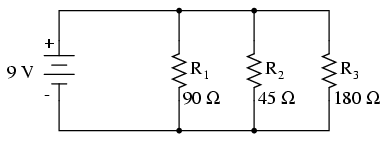
Two or more elements are connected in parallel when they share the same input and output. In this type of circuit, the potential difference of each element is the same.
To calculate the total resistance we use this formula:
1/R=1/R1+1/R2+1/R3+...
If identical batteries are connected in parallel, the voltage of the circuit wil not increase.
COMBINATION CIRCUIT
If a circuit has some elements in series and others in parallel, it is a combination circuit.
In this type of circuit, the current remains constant between elements that are connected in series. At the same time, the voltage remains constant between elements that are connected in parallel.
If you click here, you will see another explication of series and parallel circuit.
sábado, 25 de marzo de 2017
ELECTRICAL QUANTITIES
VOLTAGE OR POTENTIAL DIFFERENCE
The amount of energy that a generator can transfer to electrons depends on its voltage (V) or electric tension. This is measured in volts (V)
If we want to measure voltage, we can use a volmeter and it must be connected in parallel.
MEASURING ELECTRIC CURRENT
Electric current is the number of electrons that flow through the cross-section of a conductor every second. We can express this mathematically as follows:
I=Q/t
I=electric current
Q=coulomb
t=time (s)
Electric current is measures in amps (A) in the S.I.
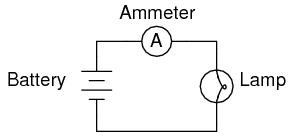
If we want to measure the electric current we use an ammeter, and it must be connected in series.

ELECTRICAL RESISTANCE: Ohm's Law
The resistance (R) of a material is equal to the voltage divided by the intensity of the electic current wich travels trough the material. This ratio, wich is called Ohm's Law, can be expressed as follows:
R=V/I
Ohm's Law has two forms:
V=RxI I=V/R
The resistance is measured in omh (Ω)
ELECTRICAL ENERGY AND POWER
ELECTRICAL ENERGY
If an electric current (I) flows at a particular tension (V) for a certain amount of time (t) we can calculate the energy (E) that is consumed: E= VxIxt
The energy is measured in joules (J)
ELECTRIC POWER
Electrical power is the energy consumed over a certain amount of time. It is measured in watts (W) or kilowatts (kW)
If an electric current (I) flows at a particular tension (V) we can calculate the power that is consumed:
P=VxI

You can click here and you will learn more about power
viernes, 24 de marzo de 2017
ELECTRIC CIRCUITS AND ELECTRONICS
AN ELECTRIC CIRCUIT
This is a pathway for the flow of electrons. It consists of the following parts, wich are connected by wires, a generator that provides energy, elements that provide control and protection, loads that receive and use energy.
AN ELECTRIC CIRCUIT
This is a pathway for the flow of electrons. It consists of the following parts, wich are connected by wires, a generator that provides energy, elements that provide control and protection, loads that receive and use energy.
PARTS OF AN ELECTRIC CIRCUIT
Electric circuits consists of various parts:
1-GENERATORS: batteries and cells
2-LOADS: light bulbs, motors, resistors and bells
3-SWITCHING DEVIDES: switches, push buttons, 3-way switches.
DIAGRAM AND SYMBOLS
Suscribirse a:
Entradas (Atom)